


‘We all share the same goals’: Tŝilhqot’in and syilx foresters learn from each other
- Dionne Phillips

- Dec 22, 2025
- 9 min read
Nk’Mip Forestry and Central Chilcotin Rehabilitation visit their respective territories, sharing knowledge and best practices.
By Dionne Phillips, Local Journalism Initiative Reporter

Separated by hundreds of kilometres and very different landscapes, Tŝilhqot’in and syilx territories in fact share similar forestry challenges.
That’s what Indigenous-owned companies are discovering after a series of site visits between operators run by bands in both nations.
Although the two forest ecosystems vary with geography, both communities are dealing with worsening wildfire and climate impacts — while also hoping to promote Indigenous-led forestry initiatives.
“They’re both, in terms of ecosystems, quite distinct from one another,” said Percy Guichon, from the Tŝilhqot’in community of Tŝideldel First Nation.
“But you know, we all share the same goals and a lot of the same values in terms of forestry practices.”
Guichon is CEO of Central Chilcotin Rehabilitation (CCR), a nearly decade-old forestry company owned by three bands within the Tŝilhqot’in Nation.
In October, it and the syilx-owned Nk’Mip Forestry invited each other to visit their counterparts’ work sites, hoping to share lessons from their respective operations.
“Even though our territories may not look the same,” Guichon told IndigiNews, “we want the healthier forests, we want safer communities and we want strong futures for our nations.”
CCR is a joint venture company owned by Tŝideldel First Nation, Tl’etinqox Government and Yunesit’in Government, the firm states on its website.
Meanwhile its syilx counterpart, Nk’Mip Forestry, started after Osoyoos Indian Band (OIB) sought to “pull together their forest management efforts” into one operation, according to the syilx First Nation’s website.

‘More of those opportunities of collaboration’
The idea of mutual site visits came after Guichon spoke to Dan Macmaster, head of forestry at Nk’Mip Forestry and a board member of the B.C. First Nations Forestry Council.
Macmaster said the collaboration is a unique opportunity to showcase the lands managed by each company, but also to share forest management practices on both sides.
“I have to say that this kind of partnership was neat,” Macmaster said in an interview, “because it went beyond just sharing ideas about forest management.”
The conversation between nations broadened to include the importance of incorporating Indigenous cultural values, “as well the distinctive ecological and social values” each community brings when working on the land, he said.
A number of Indigenous forestry committees in the province encourage such conversations and connections — including the forestry council, in which Guichon is also involved as a strategic advisor.
There’s also a Forest Landscape Planning table, Guichon explained, which has members from the Tŝilhqot’in, Secwépemc, Southern Dakelh and other nations.
“We’re all working together and collaborating on how to best manage the whole territory,” he said.
“It’s all about the land, it’s all about the water, it’s all about the wildlife.”
He added that First Nations involved in such collaborations “can put our political differences aside and our boundaries aside” to share a common cause.
“I am hopeful that there’s going to be more of those opportunities of collaboration,” Guichon said.
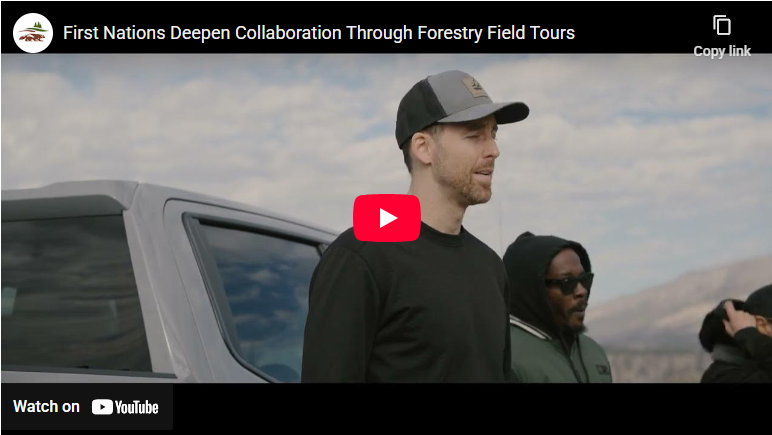
During the visit to Tŝilhqot’in territories, Guichon and the CCR team showed their Nk’Mip Forestry guests their large-scale projects, including road restoration, wildfire operations, and ecosystem management.
And when the group from Central Chilcotin Rehabilitation visited syilx homelands a few weeks later, they saw first-hand a new nursery project currently underway, and tree-thinning operations.
Guichon described it was a great learning experience. He looks forward to “continuing to build relationships with other First Nations who are involved in forestry,” he said. “I think that’s so important in this day and age to collaborate.”
‘A stronger voice to our issues’ by working together
During the tour of the Tŝilhqot’in operations, the Nk’Mip team visited the Palmer Lake wildfire recovery project site.
This biomass restoration initiative sits surrounded by a 1.2-million-hectare landscape that burned during the record-shattering 2017 wildfires.
The Nk’Mip team learned of the wood chippers their counterparts used to process charred trees.
The visitors saw how the landscape at the site and elsewhere in the territory is being managed to mitigate fire risks.

After a tour on Tŝilhqot’in territory, the group gathered in “Oliver,” to tour K&C Silviculture’s nursery.
Standing outside large white tents that house the many rows of growing trees for Nk’Mip Forestry’s operations, the CCR participants learned more about the nursery’s processes, from seeds to packaging.
From there, the group travelled to OIB’s reserve to tour the band’s new Osoyoos Forest Nursery, expected to open next summer.
Nestled at the base of an Okanagan hill are multiple structures at the new site where numerous tree species will be grown.
Visiting Nk’Mip Forestry’s joint-venture with K&C Silviculture on Okanagan Indian Band lands allowed CCR to see how the partners strengthen their relationship, in hopes of bringing home ideas.
This past spring, CCR planted over 7.5 million trees, Guichon noted. So the company is interested in finding a local tree nursery partner in a similar arrangement, hoping to expand their forestry operations into silviculture as Nk’Mip did.
After wildfires burned across Tŝilhqot’in territories repeatedly in recent years, Guichon said reintroducing trees and other native plants is essential to help the land and wildlife habitats thrive.
During the tour, CCR learned about different species the Nk’Mip nursery grew.
They plan to plant several species of berry, including soopolallie (soapberry) and saskatoon berry, to feed wildlife and community members, particularly Elders who collect berries to eat.
“Planting those berries in and around our communities is going to be a start,” Guichon noted.
‘Stewardship of the land is the number one priority’
Seeing the wildfire restoration practices in another region was inspiring to Macmaster, who noted the communities involved are all seeing fires spread further and longer each year.
“Wildfire seems to be touching us all every single year now,” he said.
Learning from forestry practices in other communities, he believes, is one way to “gather some approaches, ideas and a vision of how to deal with it.”
Meanwhile in OIB territories, there are different challenges, Macmaster explained.
Those include a history of monoculture forests, in which companies cultivated just one tree species, as well as what Macmaster called “questionable harvesting” practices from some logging operators.
“Large clearcuts have been detrimental in many ways,” he said.

Collaborating has given both companies ideas to expand and improve their processes, Macmaster said. But it’s also reminded both of some similar challenges they face — especially around revenues.
“Usually it has to do with losing money,” he acknowledged.
Although both described their companies as successful, they agreed finances present an important pressure point, particularly as they try to operate as better environmental caretakers.
“We’re out here to make sure that the stewardship of the land is the number one priority,” Macmaster said.
Guichon added that sometimes they face challenges working with government agencies, as well as securing adequate funding.
So collaborations between similar companies can help “bring a stronger voice to our issues by working together.”
“We’re much stronger when we’re united,” Guichon emphasized, “and pushing on the same front.”
A ‘responsibility to help Mother Nature’
Guichon has been particularly inspired to see an increase in First Nation-led forest operations recently.
That allows Indigenous communities to have more input as caretakers of the land for millennia.
“We know our land; we’re not going anywhere,” he said.
“We have a pretty good insight on how to help Mother Nature recover from some of these impacts, whether it’s mountain pine beetle or mega-wildfires.”
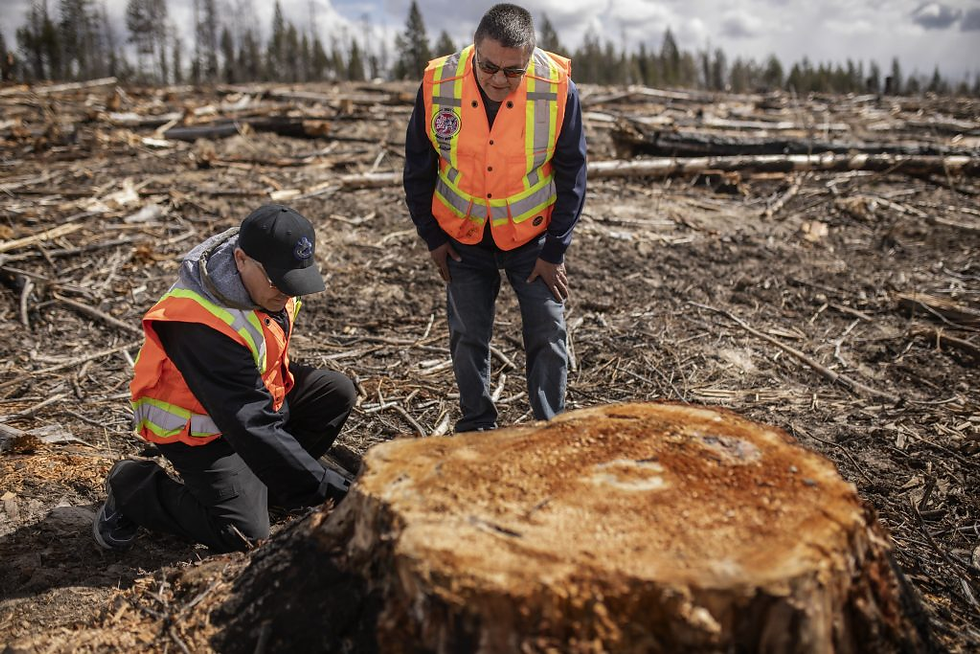
One effort underway in Tŝilhqot’in territories is to manage areas previously burned by wildfires.
The effort includes caring for standing trees so they don’t become more fuel for future fires. It also includes cleaning up burned debris, and using dead trees to create biomass to sell to pulp mills or power plants.
After fire rips through an area, Guichon noted, thousands of hectares of land are often deemed an “abandoned landscape.”
But to Tŝilhqot’in, it’s not abandoned. It’s a landscape in need of cleaning, healing and care.
In the process, he explained, they “try different things and be innovative and create jobs as well, but also helping Mother Nature.”
He explained that their practices help the land recover quicker, and improve habitat available to local native species impacted by the fires — and, they hope, creating a more resilient forest for future generations.
“As First Nations, we have that responsibility to help Mother Nature,” he said.

‘A big say on how our areas are going to be managed’
Tŝideldel — one of the three founding First Nations behind CCR — also hosts its own joint-venture company, Tsi Del Del Enterprises.
That allows the band to have control over how logging is done on their territory.
It’s through such partnerships, and being involved in processes that were already occurring on the land for centuries, that Indigenous communities are ensuring care for their homelands.
Guichon, who is also a Tŝideldel band councillor, described how land stewardship expanded beyond just CCR’s operations.
A growing number of Tŝilhqot’in communities are creating what they call “Nen Plans,” land-use documents named after the Tŝilhqot’in word for “lands and resources.”
“Community members are heavily involved in that process,” Guichon noted, “and have a big say on how our areas are going to be managed right for the future.”
But getting involved in forestry operations isn’t quick or easy for communities. Many have been planning such a move for years, but still face numerous hurdles and discussions ahead before the land use plans are completed.
Macmaster noted there are similar processes within the OIB territory, too, in which Nk’Mip communicates with community members, developing plans based on band members’ input.
“What I like when I work with the band members and glean some of the important information and ideas and knowledge,” he said, “is that we’re truly talking about what’s happening on the ground … the plants, the animals, the migratory patterns.”
Such discussions between community members and their elected leaders allow foresters to learn about areas of cultural significance, to ensure proper protocols are followed.
Macmaster described land preservation as a process. And while some areas are left in a natural state, First Nations have long helped shape and plan their surrounding landscapes in sustainable ways.
“In general,” he explained, “the landscape requires some form of management.”
Ensuring ‘that the forestry is done properly’
As different communities are increasingly building more trust in each other, neighbouring Tŝilhqot’in nations are also collaborating more.
Guichon said community members in general appear to be more open than before to working with companies run by other nearby communities, not just their own.
Macmaster has also noticed a growing number of First Nations relying on their own strengths, but also recruiting other communities to come help strengthen their forestry practices when needed.
“When they are strong in one area,” he said, those communities “are contracting and/or hiring the other band to do perhaps that part of forestry that they’re not as experienced in, or don’t have the capacity to do.”
Climate change has accelerated the need to share information and co-ordinate between communities, even though they have different climates and local conditions, Macmaster emphasized.
Working across Indigenous nations allows communities to “touch base with others who maybe have a similar ecosystem,” he explained, “or at least have a similar understanding of the changing environment that we’re dealing with.”
In a video about the two field visits, Guichon and Macmaster recognized each company’s similarities as well as their differences, and hoped to learn from both.
“It makes me feel great to know that we have a lot of similarities and a lot of parallels with the group up here,” Macmaster said.
“And we really look forward to continuing to learn from each other.”
A major hope for Macmaster is to see more and more collaboration between First Nations on forestry and land management.
In the long run, he hopes First Nations can ultimately get much more directly involved in major forest license tenures in the province — “So that the forestry is done properly,” he said, “and done with the values and priorities” Indigenous communities want to see on their lands.
Comments