


Forestry Update in the Cariboo Chilcotin: Progress Continues at Palmer Lake with Expanded Rehabilitation Activities

Williams Lake, B.C.: Central Chilcotin Rehabilitation Ltd. (CCR) is pleased to share that it continues to make strong progress at their project near Palmer Lake in the Cariboo Chilcotin with early results showing positive outcomes on the land and benefits for local communities. CCR’s team is seeing firsthand how large-scale rehabilitation work is helping bring burned forested areas back to health while creating steady employment across remote First Nations communities in the Cariboo Chilcotin.
After land rehabilitation, one of the biggest benefits has been the number of local jobs created through the project and economic spinoff. According to Daniel Persson, Registered Professional Forester and CCR’s Forestry Superintendent, every dollar that has been invested in the Palmer project is generating roughly four dollars in return, all of which goes back into jobs for Indigenous workers and communities.
“The work we are doing is more important than ever with British Columbia’s forest sector facing uncertainty due to tariffs, limited wood fibre supply, and mills curtailing operations,” noted Persson. “By taking on large scale rehabilitation work, CCR is helping create stable jobs for workers and supporting communities, many which are more rural and remote, that rely on forestry.
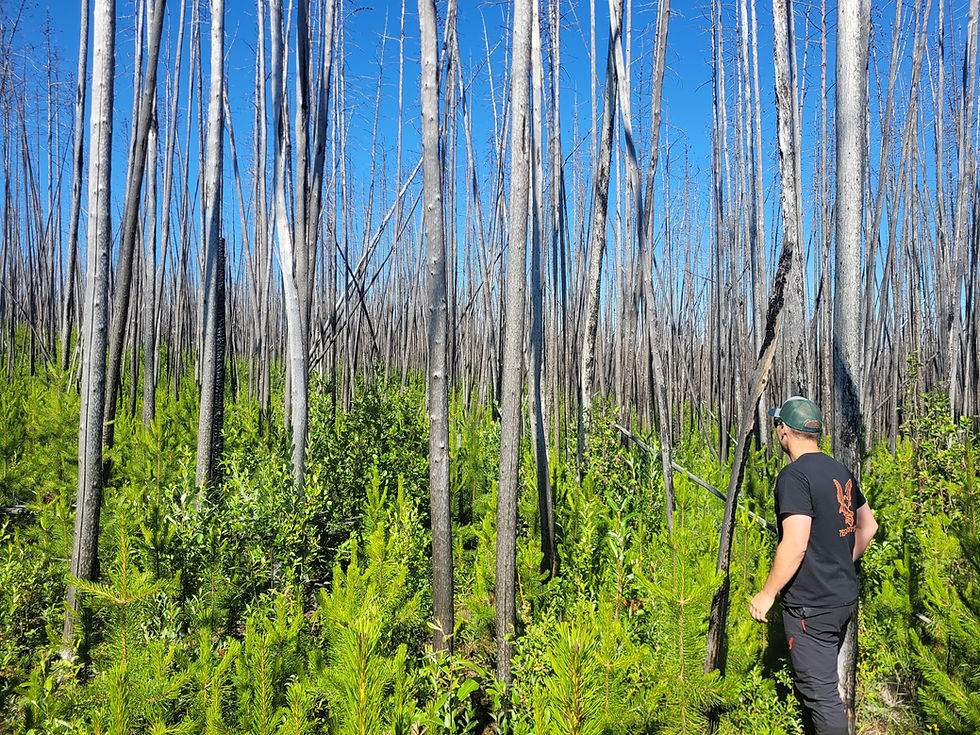
The team is also seeing major improvements to the land. Many of the forest areas being rehabilitated at Palmer were killed by catastrophic wildfire and for years have been considered too difficult to tackle. Even so, CCR has chosen to take responsibility for rebuilding the health and resilience of these damaged areas.
Aerial View of Palmer Lake Project Site Daniel Persson, Forest Superintendent, CCR at the Palmer Lake project site
“This work is imperative if we want to have healthy forests in the future,” said Percy Guichon, CEO, CCR. “We’re doing something with these dead forested areas that haven’t been touched for almost a decade.”
By utilizing burned wood, the project has been reducing the amount of forest fuels that can contribute to the severity of future wildfires. Although burnt, the wood fibre from fire-killed trees can often still be used and is transported to pulp mills and bioenergy companies, support operations at a time of scarcity of wood fibre. For CCR, the Palmer project is more than a technical effort, but one that reflects a long-term commitment to rehabilitating and healing the land.
“We would like to see more investment into this area,” Persson said. “The Cariboo Chilcotin region has been a strategic place to extract natural resources, and we’re looking to help maintain balance by investing back in the land so that this natural resource is available for many generations to come.”
As the Palmer project continues, CCR and its partners, including investments by the Forest Enhancement Society of BC and Natural Resources Canada, remain focused on creating resiliency in region.
Guichon concludes that, “CCR is proud to show what is possible when Indigenous communities can lead the work.”
About CCR
Central Chilcotin Rehabilitation is a joint venture of Tŝideldel First Nation, Tl’etinqox Government, and Yunesit’in Government. The joint venture was originally formed to address the 100,000 hectares of dead pine left in the Chilcotin region and to rehabilitate those stands into productive forests. The fires in the summer of 2017 amplified the need to address heavily burned forest stands with minimal economic value. CCR’s mission is to coordinate and implement large-scale forestry programs and initiatives within the traditional territories of the Tŝideldel First Nation, Tl’etinqox Government, and Yunesit’in Government, generating economic, social, and environmental benefits. For more information: www.centralcr.ca
Follow CCR on social media:
Twitter/X: https://x.com/centralcr_ca
For an Interview with CCR or information on partnership opportunities, contact:
Aleece Laird, Communications Liaison, aleece@amplifyinc.ca, 250.574.0221
Comments